NYU Medieval and Renaissance Center Distinguished Lecture Series Spring 2019
MARCH 7 | 5 PM, 1ST FLOOR GREAT ROOM | 19 UNIVERSITY PLACE
"Just War" and "Conspicuous Crimes": Elizabeth Casteen, Binghamton University
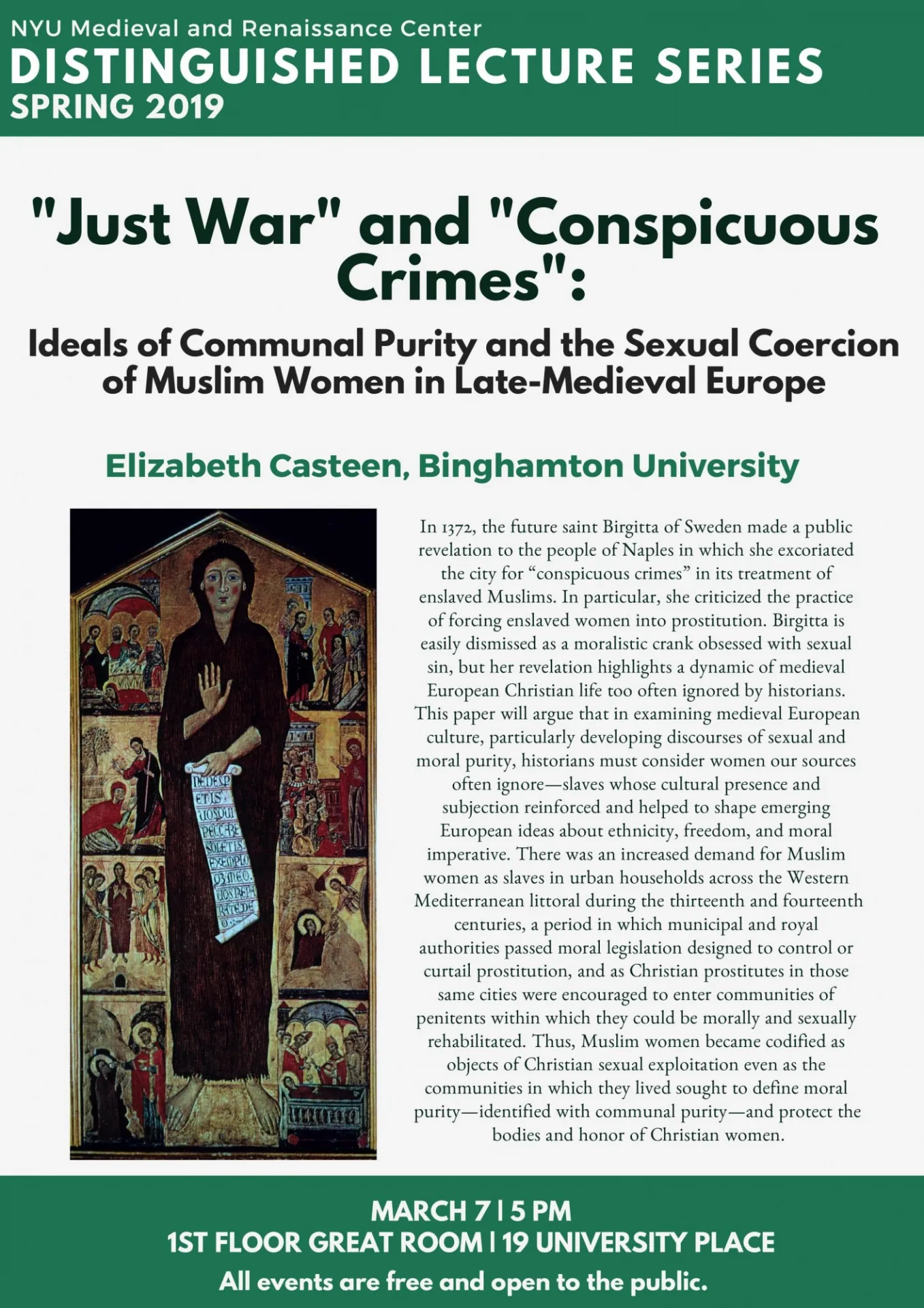
1372, the future saint Birgitta of Sweden made a public revelation to the people of Naples in which she excoriated the city for “conspicuous crimes” in its treatment of enslaved Muslims. In particular, she criticized the practice
of forcing enslaved women into prostitution. Birgitta is easily dismissed as a moralistic crank obsessed with sexual sin, but her revelation highlights a dynamic of medieval European Christian life too often ignored by historians. This paper will argue that in examining medieval European culture, particularly developing discourses of sexual and moral purity, historians must consider women our sources often ignore—slaves whose cultural presence and subjection reinforced and helped to shape emerging European ideas about ethnicity, freedom, and moral imperative. There was an increased demand for Muslim women as slaves in urban households across the Western Mediterranean littoral during the thirteenth and fourteenth centuries, a period in which municipal and royal authorities passed moral legislation designed to control or curtail prostitution, and as Christian prostitutes in those same cities were encouraged to enter communities of penitents within which they could be morally and sexually rehabilitated. Thus, Muslim women became codified as objects of Christian sexual exploitation even as the communities in which they lived sought to define moral purity—identified with communal purity—and protect the bodies and honor of Christian women.
All events are open to the public.