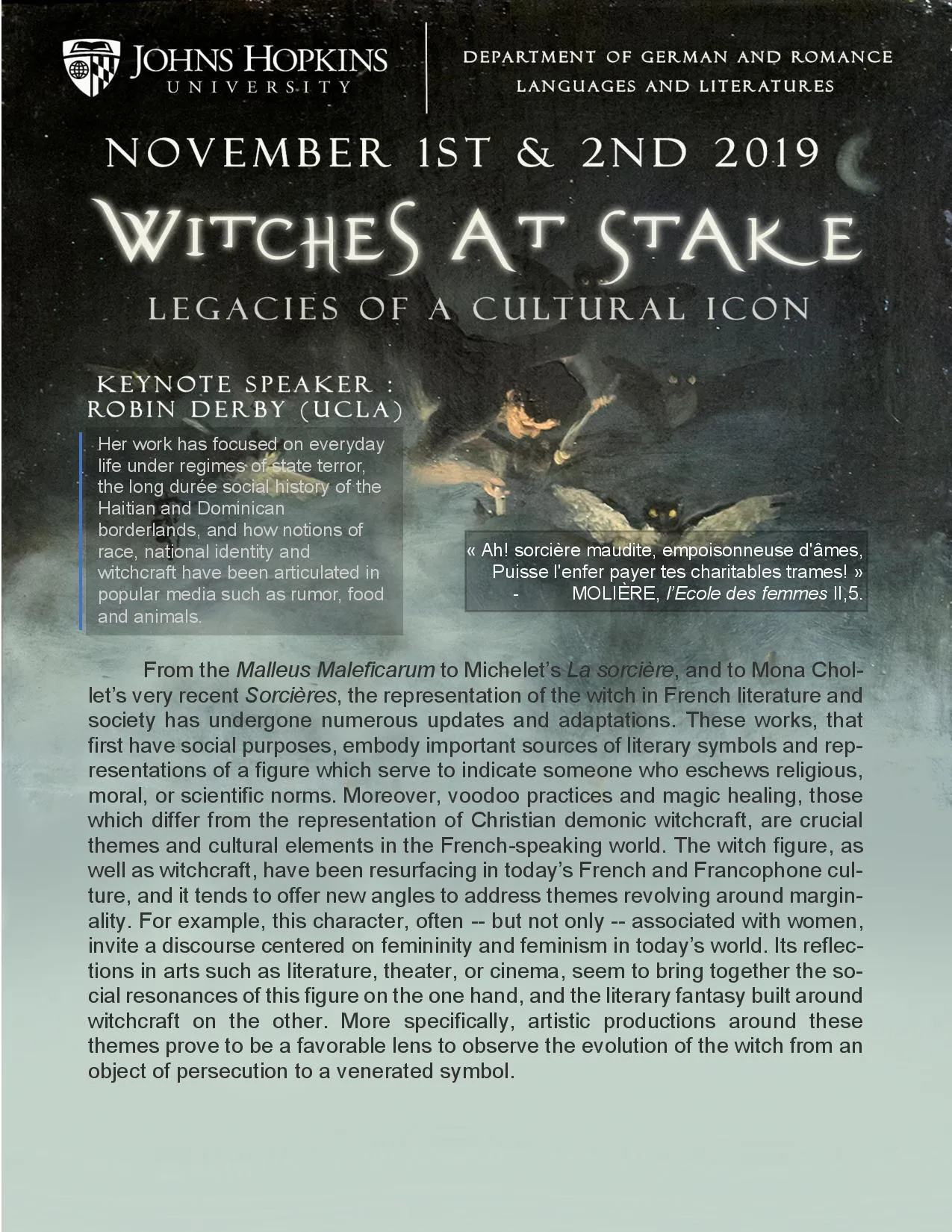
From the Malleus Maleficarum to Michelet’s La sorcière, and to Mona Chollet’s very recent Sorcières, the representation of the witch in French literature and society has undergone numerous updates and adaptations. These works, that first have social purposes, embody important sources of literary symbols and rep-
resentations of a figure which serve to indicate someone who eschews religious, moral, or scientific norms. Moreover, voodoo practices and magic healing, those which differ from the representation of Christian demonic witchcraft, are crucial themes and cultural elements in the French-speaking world. The witch figure, as well as witchcraft, have been resurfacing in today’s French and Francophone culture, and it tends to offer new angles to address themes revolving around marginality. For example, this character, often -- but not only -- associated with women, invite a discourse centered on femininity and feminism in today’s world. Its reflections in arts such as literature, theater, or cinema, seem to bring together the social resonances of this figure on the one hand, and the literary fantasy built around witchcraft on the other. More specifically, artistic productions around thesethemes prove to be a favorable lens to observe the evolution of the witch from an object of persecution to a venerated symbol. Her work has focused on everyday life under regimes of state terror, the long durée social history of the
Haitian and Dominican borderlands, and how notions of race, national identity and witchcraft have been articulated in popular media such as rumor, food and animals.
Since the number and variety of representations and adaptations of witchcraft are endless, our conference aims to explore the theme of witchcraft throughout French and Francophone arts and how the oppressed witch has become one of today’s important feminist figures. Our wish is to question how these marginal characters representing minorities never cease to be adapted to the changing religious, social and political needs and expectations. We welcome proposals on works ranging from the Middle Ages to the 21st century that explore questions such as: how are witches and witchcraft represented in literature, film, and other arts? Why is there an ongoing fascination for witches and witchcraft? How are the social constructs of this figure reflected in literary works at a given time? How does the medieval portrayal of the witch nourish contemporary feminist discourses? What makes this figure so literary and socially adaptable?
Potential topics may include but are not limited to:
· Witches, wizards and witchcraft in French and Francophone arts and
literature
· Religious repression
· Representation of Gender and Sexuality
· Marginality
· Fantastic literature
· History of violence and persecution
· Monsters, transformations and hybridity
· Voodoo, shamanism and black magic
· Demons and witches’ companions
You are invited to submit a 250-word abstract with key words in either English or French by April 2nd, 2019 to our email address: [email protected]. Please include: a brief résumé, the title of your presentation, as well as your name and your academic affiliation. Please send any additional questions you may have to the aforementioned email address.